
Kiln refractory doesn’t fail on a schedule. It fails at the weak point you didn’t know you had.
That’s a harder problem than it sounds. A rotary kiln runs continuously, rotates constantly, and exposes its lining to a moving combination of heat, chemical attack, and mechanical stress that shifts depending on where material sits in the process. Two kilns processing the same material can wear in completely different patterns depending on burner alignment, feed chemistry, and how the shell has settled over years of operation. A maintenance plan built around a calendar date instead of the kiln’s actual condition is a plan that gets surprised eventually.
This is especially true in mineral processing, where kilns handle everything from cement clinker to lime, alumina, and various ore concentrates. Each material brings its own thermal and chemical profile, and the refractory lining has to hold up to all of it while the shell keeps turning.
What Makes Rotary Kiln Refractory Wear Different
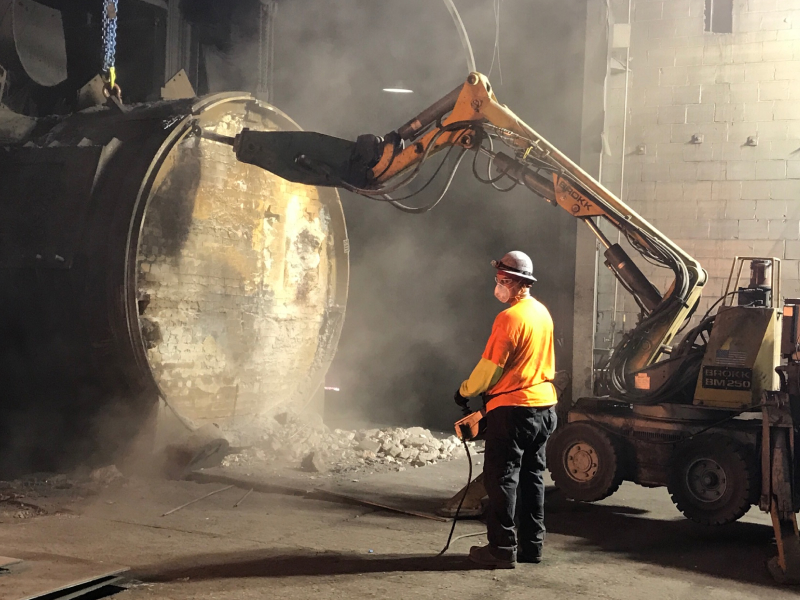 Most furnace refractory deals with heat in a relatively fixed geometry. A rotary kiln adds motion to that equation. The lining experiences repeated flexing as the shell rotates, and any ovality in the shell (even slight) translates into cyclical stress on the brick or castable lining with every rotation. Over months and years, that cyclical loading can loosen anchors, open joints, and create the kind of small gaps where hot gas and process material work their way behind the hot face.
Chemical attack compounds the mechanical wear. Alkali vapors, sulfur compounds, and chlorides common in mineral processing feeds can penetrate refractory and react with it over time, weakening the structure from within before any visible damage shows up on the surface. This kind of degradation is often invisible during a walk-through inspection and only becomes obvious once a section has thinned enough to affect shell temperature.
The Zones That Typically Wear First
Every kiln is different, but certain zones tend to show wear earlier than others in mineral processing applications.
The burn zone sees the highest temperatures in the kiln and is usually where material selection matters most. This is often where basic brick or high-alumina castable is specified, and where thermal cycling from burner adjustments or process upsets does the most damage.
Transition zones, where temperature changes rapidly along the kiln length, tend to experience more thermal shock than steady-state zones. Refractory here needs to tolerate temperature swings, not just peak heat.
The discharge end often sees mechanical abrasion from material tumbling against the lining as it exits, in addition to whatever thermal and chemical exposure carries over from upstream.
Areas near tires and support rollers are worth watching for a different reason. Shell ovality tends to be most pronounced near these support points, which means the refractory there absorbs more cyclical stress than sections of shell further from a tire.
Knowing which zone is showing wear tells you a lot about the likely cause, and that matters for deciding whether the fix is a material change, an anchoring adjustment, or an operational one.
Building a Maintenance Plan Around Kiln Condition, Not Just a Calendar
A fixed inspection interval is a reasonable starting point, but it shouldn’t be the whole plan. A few practices tend to catch problems earlier than a calendar alone.
Shell temperature scanning during operation, using infrared, can flag hot spots before they become visible refractory failures. A consistent scanning routine, done at the same operating conditions each time, makes it easier to spot a developing trend rather than a one-off reading.
Internal inspections during planned shutdowns should go beyond a visual walk-through. Checking joint condition, anchor integrity, and lining thickness in the zones known to wear fastest gives a more complete picture than checking only the areas that look obviously worn.
Tracking wear patterns over multiple outages turns individual inspections into a maintenance history. If the same zone keeps showing accelerated wear, that’s a signal worth investigating further, whether the cause turns out to be material selection, burner alignment, or something in the feed chemistry.
Coordinating with process data where possible helps connect refractory condition to what was actually happening in the kiln. A period of elevated wear that lines up with a feed change or a process upset is more useful information than wear that seems to appear without explanation.
None of this eliminates the unpredictability that comes with kiln operation. It does reduce the odds of finding a failure only when it’s already forced an unplanned shutdown.
When Repair Makes Sense vs. When Reline Does
This decision depends heavily on the specifics of a given kiln, its history, and the extent of the wear found during inspection, so it’s not something to generalize without a direct look at the actual conditions. In general terms, localized wear in a single zone, caught early, can often be addressed with a targeted repair during a planned outage. Widespread thinning, repeated failures in the same area despite prior repairs, or wear that’s approaching the working lining thickness across a larger section of the kiln tends to point toward a more comprehensive reline being the more cost-effective path over the next several operating cycles.
An experienced refractory contractor can help evaluate which situation you’re in based on inspection data, wear history, and the kiln’s operating parameters.
Key Takeaways
- Rotary kiln refractory wear is driven by a combination of thermal cycling, mechanical flexing from shell rotation, and chemical attack from process gases and material.
- The burn zone, transition zones, the discharge end, and areas near tires or support rollers tend to show wear earliest, though this varies by kiln and application.
- A maintenance plan built around actual kiln condition, using shell scanning, thorough internal inspections, and wear tracking over time, tends to catch developing problems earlier than a fixed calendar interval alone.
- Whether a repair or a full reline makes sense depends on the extent and location of wear, and is best evaluated with a direct inspection.
If it’s been a while since your kiln’s refractory condition has been fully assessed, or if you’ve noticed wear patterns that keep repeating in the same area, Schad’s team can help evaluate what’s driving it and what your options look like. Reach out via our contact form or by phone at 800-581-7885.